


Experts in what we do
Point of View
In a polarized U.S. political landscape and amid unresolved geopolitical tensions, the 2026 U.S. midterm elections represent an important milestone for financial markets. For investors, the key question is whether the election results, and the noise and uncertainty surrounding them, will prove supportive or detrimental to portfolios. Should we position for volatility, or maintain an even more bullish stance?

2026 has so far been a year of strong equity market performance, with the technology and energy sectors firmly in the lead. At the time of writing, the S&P 500 is up +12.7% and the Nasdaq index +14.1%. Earnings growth in the first two quarters has been exceptionally strong, while the macroeconomic backdrop remains supportive of risk assets. International political risks such as the war in Iran, trade tariffs, and the U.S. debt level surpassing $40 trillion have not materially dented equity valuations. The risks that were flashing red on our radar have not disrupted the prevailing trends. Can the U.S. midterm election results on November 3rd affect the equity trend?
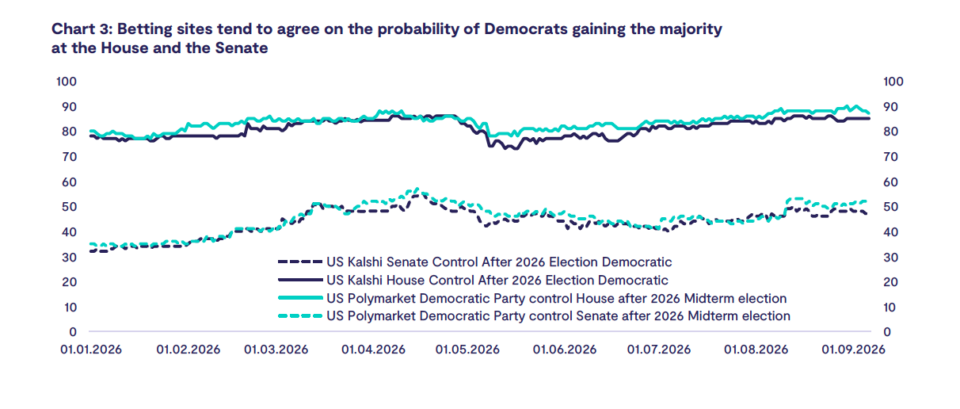
Given President Trump’s approval rating and the latest political developments, a change in congressional control appears possible. The probability of Democrats winning the House of Representatives looks elevated, as they need a net gain of only three seats, while control of the Senate remains genuinely competitive. Betting markets currently reflect this dynamic (chart 2), implying roughly an 80% chance of Democrats winning the House, but only a 53% chance of taking the Senate. A split Congress therefore appears the most likely outcome at this stage.
Such a stalemate could be viewed positively, as it may constrain large fiscal initiatives or sweeping regulatory overhauls. On the other hand, a split Congress introduces gridlock, making consensus on difficult decisions regarding spending and debt-limit obligations more difficult. Market reactions are therefore hard to predict, particularly given that a Republican majority is generally perceived as pro-business and supportive of markets.
Although each election cycle is unique, a change in congressional majority is not unprecedented. We analyzed S&P 500 returns in each midterm election year since 1930 (24 elections) to assess whether historical majority changes offer any guidance (chart 1 and 2). We compared index performance before versus after the elections through year-end, across all election outcomes versus cases with a change in majority, and further isolated years in which the first ten months were positive, as in 2026.
1
markets reacted positively
On average, markets reacted positively to election results by +3.1% (+13.0% annualized), whereas the first ten months were negative on average (-0.5%). Weattribute the mediocre pre-election returns to a risk premium associated with the fear of unexpected change, which tends to dissipate once the outcome is known. Post-election returns are positive in 66% of cases.
2
post-election return
3
No change in Majority
By contrast, cases with no change in majority in either chamber show the strongest statistics, with average post-election returns of +5.3% (+22.8% annualized)and only 2 negative outcomes out of 12.
4
positive post-election returns
Finally, given 2026’s strong performance to date, we examined cases with positive pre-election returns.There is no reversal: average post-election returns stand at +3.7% (+15.6% annualized). Notably, years with negative year-to-date returns also exhibit positive post-election performance of +2.5%.
In conclusion, across all scenarios considered, post-election returns are on average positive. A shift to Democratic control is the least favorable outcome historically, though still positive on average, with half of such elections ending the year with negative returns. If history is any guide, investors should not be overly alarmed by the upcoming midterm elections. We continue emphasizing equities in our investment strategy.

July 2026
Equity and bond market indices recorded lacklustre performance
Global market performance shaped by geopolitical tensions, inflation concerns, and volatility in AI-related technology stocks.
Read article

May 2026
May marked the comeback of the 2025 return drivers.
Oil prices eased during the month on hopes of a diplomatic breakthrough.
Read article

September 2026
Rising interest rates and market volatility
An overview of September’s financial markets, examining rising bond yields, persistent inflationary pressures, geopolitical uncertainty and their impact on global asset classes, alongside BlueBox’s investment outlook and asset allocation strategy.
Read article