
May 2026

May marked the comeback of the 2025 return drivers.

Download as pdf

1

Equities extended their May rally, led by the technology sector and Asian emerging markets.

2

No resolution appears imminent in the Iran conflict despite ongoing negotiations; the Strait of Hormuz remains closed. Oil prices eased during the month on hopes of a diplomatic breakthrough.

3

Inflation is accelerating globally, driven by persistently high energy prices.

4

Interest rates are trending higher and exhibiting greater volatility, resulting in muted bond returns.

Authored by Gilles Prince
Chief Investment Officer

Experts in what we do

Last month

May marked the comeback of the 2025 return drivers. Technology equities led the
rebound, posting a 15.8% gain for the month, powered primarily by semiconductors (+25.5%). Growth and cyclicals rallied alongside an all‑encompassing AI theme that is currently the dominant market narrative, while bonds lagged amid accelerating inflation and volatile long‑term yields. 

After subdued performance since Q4 2025, technology — and semiconductors in particular — began to outperform from early April and saw renewed demand in May. AI is the primary catalyst, drawing investor capital to companies with direct or cascading AI revenue exposure. The Philadelphia Semiconductor Index (SOX) is up 81% year‑to‑date, its strongest start to a year since 1999. Software names that were previously viewed as potential AI losers — a position we contested — participated in the late‑month rally and finished May up c.20%, though they remain negative on the year.

The rapid breadth and speed of the rally have revived concerns about financial excess
given the macroeconomic and geopolitical backdrop. Valuation multiples have expanded quickly in a melt‑up pattern that resembles a FOMO (Fear Of Missing Out) dynamic. We are surprised that the majority of market participants dismiss the potential impact of an unprecedented energy disruption from the Strait of Hormuz closure. With the VIX low at 15.3% and our risk indicator back in negative territory, signs of complacency are becoming apparent. This does not imply an imminent correction — markets can continue to advance — but equity valuations are more vulnerable to an adverse surprise as summer approaches.

The macroeconomic backdrop remains supportive. Manufacturing PMIs are comfortably above 50 and trending higher, helped by accommodative fiscal stances and AI‑related investments. Financial conditions are loose and the solid pre‑war economic momentum appears intact, which underpins equities. The principal macro risk is accelerating inflation: the latest headline prints stand at 3.8% in the US and 3.0% in the EU. Euro‑area futures imply roughly 2.5 ECB hikes through the remainder of 2026, implying the ECB is ready to fight against the accelerating inflation. On the other hand, US futures markets show less conviction for 2026 Fed hikes, reflecting the new Fed chair Kevin Warsh position on interest rate and inflation. This policy uncertainty is contributing to bond market volatility: the US 10‑year yield peaked at 4.66% before settling near 4.43% while remaining in an uptrend. We continue to view long‑term yields as having upside risk and therefore maintain an underweight and short duration stance on bonds within multi‑asset allocations.

In sum, May’s performance was equity‑technology-driven with limited bond contribution. We recognise the risks to equities but, given the supportive macro backdrop and ongoing AI‑led flows, we remain fully invested for now.
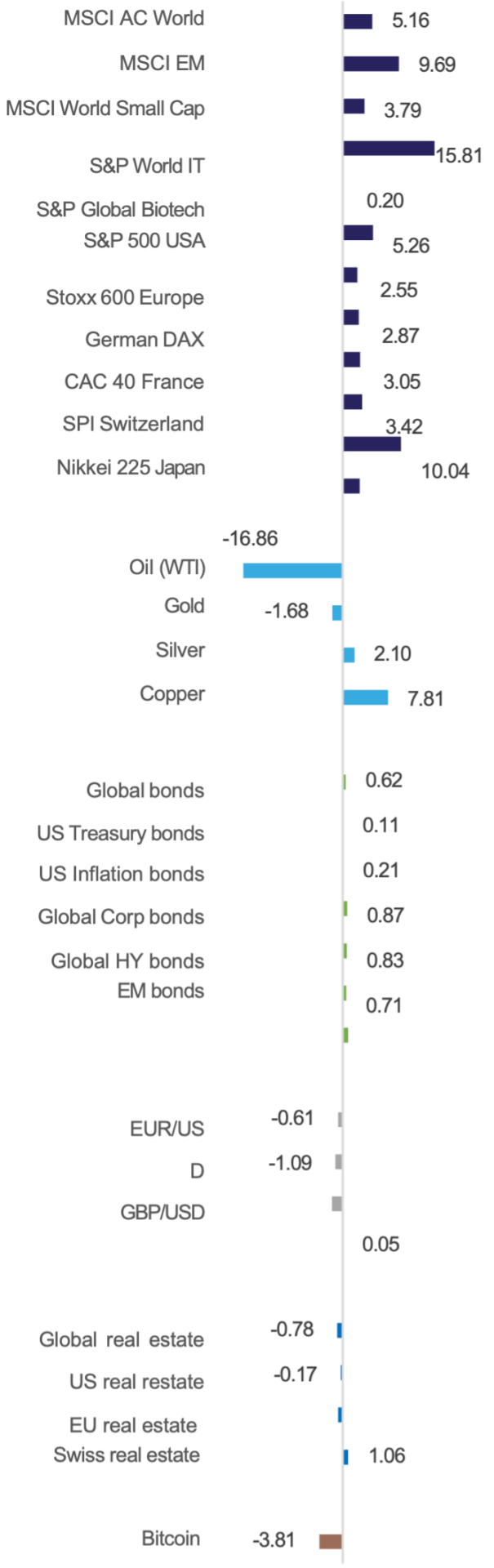
Scorecard

(In %, USD)

Monthly performances

Experts in what we do

The Views

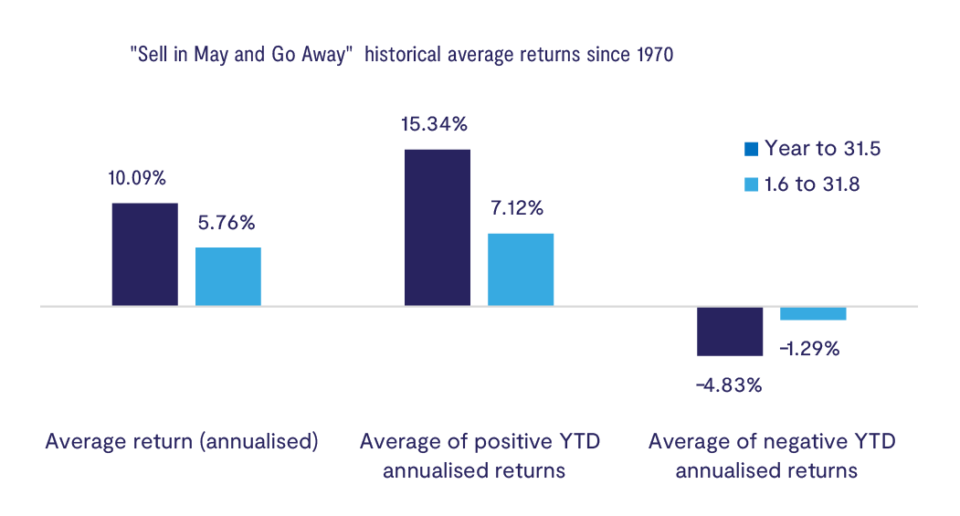
Sell in May and Go Away or The Trend is Your Friend ? 

It is an old financial adage that investors should “sell in May and go away,” implying that it is prudent to crystallise profits before the summer period. Lower trading volumes in the summer months and related seasonal effects are commonly cited reasons for this practice. Historical evidence of systematically negative returns after May is, however, inconsistent. Still, invoking proverbial investing wisdom is rarely misplaced—especially now, when investors are sitting on sizeable gains after a strong 2025 and face two divergent scenarios.

Positive forces supporting equities include a solid economic backdrop, abundant liquidity, resilient corporate earnings and ongoing capital investment across the AI value chain. In the US, Europe and Japan, leading and coincident indicators remain well oriented; manufacturing PMIs are comfortably above 50 in most regions. Despite elevated energy prices, demand has held up and there is little evidence so far of a major economic disruption.

On the negative side, the unprecedented energy shock has renewed inflationary pressures worldwide. Central banks may need to raise policy rates to contain inflation, thereby dampening demand. The impact will be heterogeneous: some economies are net energy exporters, while others have reduced oil intensity. If the Strait of Hormuz remains closed, strategic reserves will be drawn down and further rationing and price increases are likely. Combined with rate hikes, these developments could undermine the equity rally and prompt investors to reassess the resilience of the expansion.

In summary, equities currently face a duality: an ageing but still-accelerating trend that appears increasingly vulnerable to a correction, and a macro scenario that could materially alter the growth trajectory—albeit starting from a solid baseline. For now,
“the trend is your friend” appears to prevail among market participants. Nonetheless,
investors with available liquidity should exercise caution and consider phased deployment over the summer to take advantage of potential dislocations.

We tested the “sell in May” strategy by comparing S&P 500 returns year‑to‑date through the end of May since 1970 with returns from June through August. We did that for all, positive and negative year-to-date returns. Our objective was to determine whether a strong start to the year through May is historically followed by negative summer returns. The short answer is no: a strong start does not reliably predict a negative summer. That said, average summer returns have been lower, reflecting a mix of trend persistence and mean reversion. All else equal, a blanket “sell in May” rule does not appear to be a robust strategy.

Risk Indicator

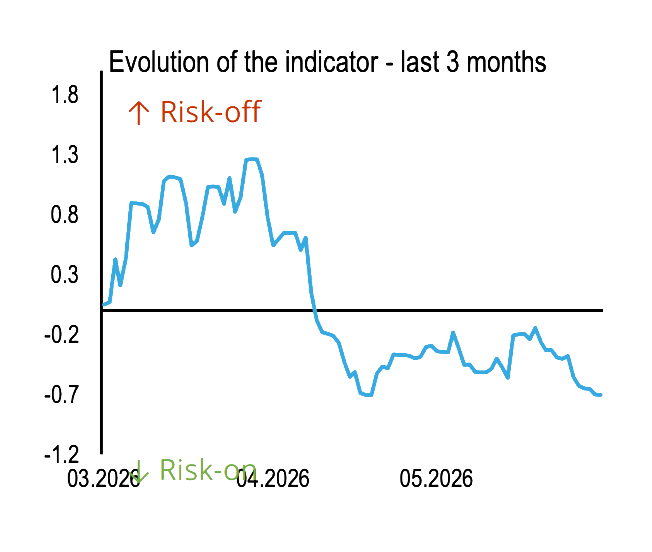
The Bluebox risk indicator dipped further into negative territory reflecting the positive sentiment prevailing in financial
markets. At -0.70 it is heading towards complacency levels, a sign of a very positive market situation, but also a fragile one as excesses tend to be corrected sooner than later. Markets are optimistic to say the least, maybe not yet euphoric, meaning that markets will march forward in the absence of game-changing news.

The BlueBox Global Risk Indicator summarizes 20 market variables such as implied volatilities, implied correlations, or credit spreads into a normalized index. A positive number indicates a higher-than-average risk level, i.e. market stress. Low levels are indicators of normally behaving markets, while strongly negative readings (<-1) correspond to market complacency. The indicator is global and can be compared to a speedometer of financial markets. Please contact us for further information. 

March 2026

March has been a challenging month

Most asset classes declined, with the exceptions of energy prices and the US dollar.

Read article

May 2026

May marked the comeback of the 2025 return drivers.

Oil prices eased during the month on hopes of a diplomatic breakthrough.

Read article

June 2026

Was “Sell in May” the right call in the end?

Global markets paused as AI leadership shifted, inflation stayed elevated, and diversification became more critical.

Read article