

March 2026

March has been a challenging month

Download as pdf

1

The war in the Middle East is disrupting financial markets and makes investors reassess the inflation and growth outlook

2

Bonds, equities and gold prices are down – volatility, the dollar and oil prices are up 

3

There is no place to hide as inflation fears make both bonds and equities lose value

4

The duration of high energy prices is key for assessing economic consequences 

Authored by Gilles Prince
Chief Investment Officer

Experts in what we do

Last month

March has been a challenging month for financial markets. Most asset classes declined, with the exceptions of energy prices and the US dollar. After two strong opening months, March pushed most financial indices into negative territory for 2026. 

The ongoing conflict in the Middle East, including damage to key energy infrastructure and the closure of the Strait of Hormuz, has driven oil and natural gas prices to levels not seen since the onset of the war in Ukraine. As the confrontation has evolved from a short military operation into a prolonged conflict, investors are reassessing the economic consequences of persistently higher energy costs. Inflation expectations are rising, with some economists now projecting that US headline inflation could approach 4%. Consequently, market participants have adjusted their expectations for monetary policy — shifting from rate cuts to the potential for further tightening.

As is typical with supply-driven shocks, the effect on global growth is likely to be negative, a risk that should not be underestimated. Financial markets are currently in a first-stage adjustment phase, incorporating heightened uncertainty regarding the duration of the war and its broader macroeconomic impact. Yields are rising, credit spreads widening, and implied volatilities increasing. Investors are taking profits on gold — and, to a lesser extent, equities — while holding higher levels of cash until clearer trends emerge. Supported by a stronger US dollar, US equities continue to outperform global peers. The technology sector, having underperformed over the past six months, has shown relative resilience since the conflict began. Bitcoin has similarly advanced by about 4% in March. Once again, the pattern of “sell first, ask questions later” has weighed most heavily on the most crowded positions.

As in 2022, albeit on a smaller scale, both bonds and equities have corrected simultaneously. The combination of rising inflation risks and slowing growth has pressured both asset classes, resulting in negative returns for many multi-asset portfolios. Building resilient portfolios capable of delivering sustained performance while limiting drawdowns remains a complex challenge. In March, short-term, high-quality fixed income and timely equity index put options helped cushion losses but did not offset declines in equities, credit, and gold. Some managed futures and alternative strategies delivered positive performance, though manager selection remains critical to success.

History suggests that investors should avoid overreacting in periods of market stress. Conversely, long-term investors often find opportunities as sentiment reaches extreme pessimism. Looking ahead, we continue to see renewed long-term potential in alternative energy and electrification themes, while high-yield bonds appear attractive given the higher yield.
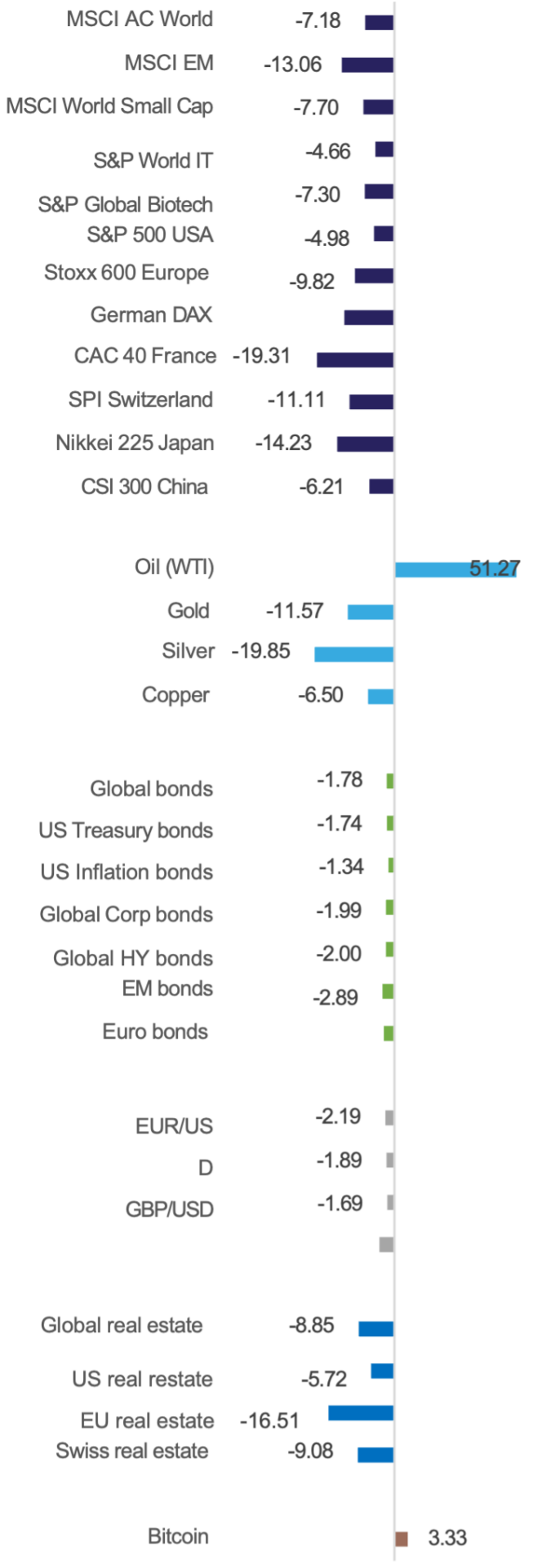
Scorecard

(In %, USD)

Monthly performances

Experts in what we do

The Views

The consequences of the war in the Middle East 
We know when a war begins, but not when it ends. The ambiguity surrounding U.S. military objectives, the inconsistent communication from the White House, and Iran’s retaliatory stance and struggle for survival all contribute to the proverbial “fog of war,” which is now a tangible reality for financial markets. The lack of visibility makes any assessment of economic consequences highly uncertain. Nonetheless, it is important to acknowledge that the evolution of events could prove a game changer for our tactical positioning.

In this context, the key variable for investors is the level and duration of elevated energy prices. For oil and gas to have meaningful macroeconomic repercussions, prices must remain high enough for long enough to impact not only headline but also core inflation— 
and, more critically, economic growth. Energy supply shocks are inherently restrictive and place central banks in a difficult position as inflationary pressures rise. Below, we outline three potential scenarios, each carrying distinct portfolio implications. The associated probabilities are inevitably subjective given the prevailing uncertainty.

1

De-escalation

Probability 25–35%

In this optimistic scenario, a unilateral U.S. declaration of victory, a cease-fire, or the start of genuine negotiations would quickly ease tensions and enable the gradual reopening of the Strait of Hormuz. Brent prices could retreat toward USD 75 per barrel, though not to pre-war levels due to infrastructure damage. Equity markets would likely rally toward recent highs, and rotation into non-U.S. markets could resume. The U.S. dollar would weaken as capital is redeployed, while gold would extend its upward trend, supported by lingering inflation fears. 

2

Status quo

Probability 40–50% 

Hostilities persist but remain contained, avoiding large-scale civilian or critical infrastructure damage. Limited traffic through the Strait of Hormuz would resume for select Iranian counterparties, easing some pressure on net energy importers. Oil prices would stabilize around USD 90–100 per barrel. Given that European and Asian economies are more exposed to higher energy costs, the recent rotation out of U.S. equities would stall. The U.S. dollar would remain firm, supporting continued relative outperformance of U.S. markets. Volatility, however, would remain elevated as investors refocus on inflation and growth data amid persistently high energy prices. 

3

Escalation

Probability 35–45% 

This adverse scenario assumes an intensification of hostilities, with possible involvement of neighboring and NATO countries, renewed attacks on civilian and energy infrastructure, and heightened insecurity in critical maritime routes such as the Strait of Bab el-Mandeb and the Suez Canal. In this case, oil prices could surge above USD 150 per barrel. A sharp inflation shock would likely prompt central banks to respond with renewed policy tightening. Bonds and equities would sustain further losses, potentially marking the onset of a bear market. In such an environment, real assets and gold would offer inflation protection, while the U.S. dollar would appreciate further as a safe haven. 
From an asset allocation standpoint, volatility is expected to remain elevated in the near term. While valuations in certain asset classes are becoming more attractive for long-term investors, we maintain our protective positioning for the time being.

Risk Indicator

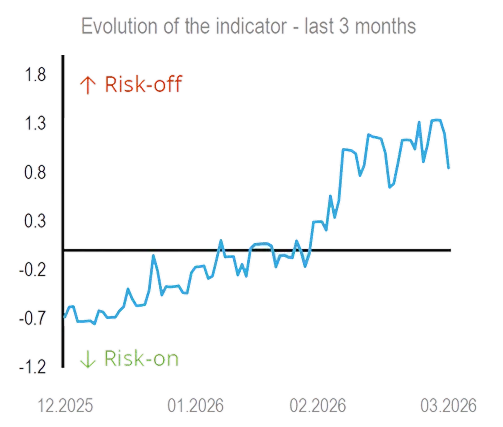
The Bluebox risk indicator reached a high level of 1.3 reflecting the global stress in financial markets. All segments of the index, market, credit, skew, or liquidity increased significantly. Markets are therefore very sensitive to the news flow and evolution of the energy crisis. Financial markets and equities in particular are likely to potentially move fast, either down in case of war escalation or up should the hostilities stop. 

The BlueBox Global Risk Indicator summarizes 20 market variables such as implied volatilities, implied correlations, or credit spreads into a normalized index. A positive number indicates a higher-than-average risk level, i.e. market stress. Low levels are indicators of normally behaving markets, while strongly negative readings (<-1) correspond to market complacency. The indicator is global and can be compared to a speedometer of financial markets. Please contact us for further information. 

March 2026

March has been a challenging month

Most asset classes declined, with the exceptions of energy prices and the US dollar.

Read article

May 2026

May marked the comeback of the 2025 return drivers.

Oil prices eased during the month on hopes of a diplomatic breakthrough.

Read article

June 2026

Was “Sell in May” the right call in the end?

Global markets paused as AI leadership shifted, inflation stayed elevated, and diversification became more critical.

Read article