
Opens in a new tab

September 2026

Rising interest rates and market volatility

Download as pdf

1

In September, the Fed, ECB and BoJ raised policy rates; the SNB held steady.

2

Energy prices increased, lifting inflation expectations. Energy equities nonetheless posted negative returns, pressured by President Trump’s reported threat to ban diesel exports.

3

US economic data surprised to the upside, confirming economic resilience.

4

All equity sectors declined except AI-related industries. Broad indices closed roughly flat; dispersion remained elevated.

Authored by Gilles Prince
Chief Investment Officer

Experts in what we do

Last month

Following the summer recess, September proved challenging across most asset classes. Dispersion and volatility prevailed, with the technology sector again offering the only meaningful refuge.

The market narrative has centred on interest rates since late summer. Long-dated sovereign yields rose sharply in September, with the US 10-year Treasury yield increasing from 4.75% to 5.28%. The move was global and, in some cases, concerning given local fiscal dynamics. In France, the 10-year OAT yield reached 4.85%, widening the spread over the German 10-year Bund to around 130 basis points, levels not seen since the eurozone sovereign debt crisis of 2012. In this environment, broad bond indices declined by roughly 2% for the month and are only marginally positive year to date, while remaining under pressure.

Macroeconomic data releases broadly supported the case for a resilient economy. US quarter-on-quarter GDP surprised to the upside at 2.2%, while both manufacturing and services PMIs advanced comfortably into expansion territory in September. On the inflation front, the PCE price index, the Fed’s preferred gauge, edged down by 0.3 percentage points to 3%. However, this apparent improvement was largely methodological: the Bureau of Economic Analysis revised its calculation approach in its annual review, with an estimated −0.3 percentage-point impact, implying that underlying inflationary pressures have not materially eased.

Equity indices also struggled, with most finishing the month down or flat. More technology-concentrated benchmarks, such as the S&P 500 and the MSCI Emerging Markets Index, were roughly flat, as technology and communication services were the only sectors posting positive returns in September. Dispersion was elevated, with more highly leveraged sectors underperforming most sharply in response to higher rate levels. In Europe, France’s political and fiscal situation weighed on local equities, with the CAC 40 now negative year to date.

Gold surrendered almost all of its August gains, pressured by a stronger US dollar and higher real rates. Nevertheless, we continue to view the fundamental backdrop as supportive over the medium term. Bitcoin has increasingly been perceived as an alternative to bonds and equities, with its rebound continuing; in September, it was among the few asset classes posting positive returns and offering welcome diversification. Oil and distillates advanced for the month but retreated from recent highs, as unconfirmed reports regarding a potential US ban on diesel exports under President Trump introduced additional volatility.

Heightened political and geopolitical uncertainty, combined with significant moves in key market drivers, has blurred investors’ visibility. We maintain our current asset-allocation stance: a preference for technology within equities and short duration within fixed income.
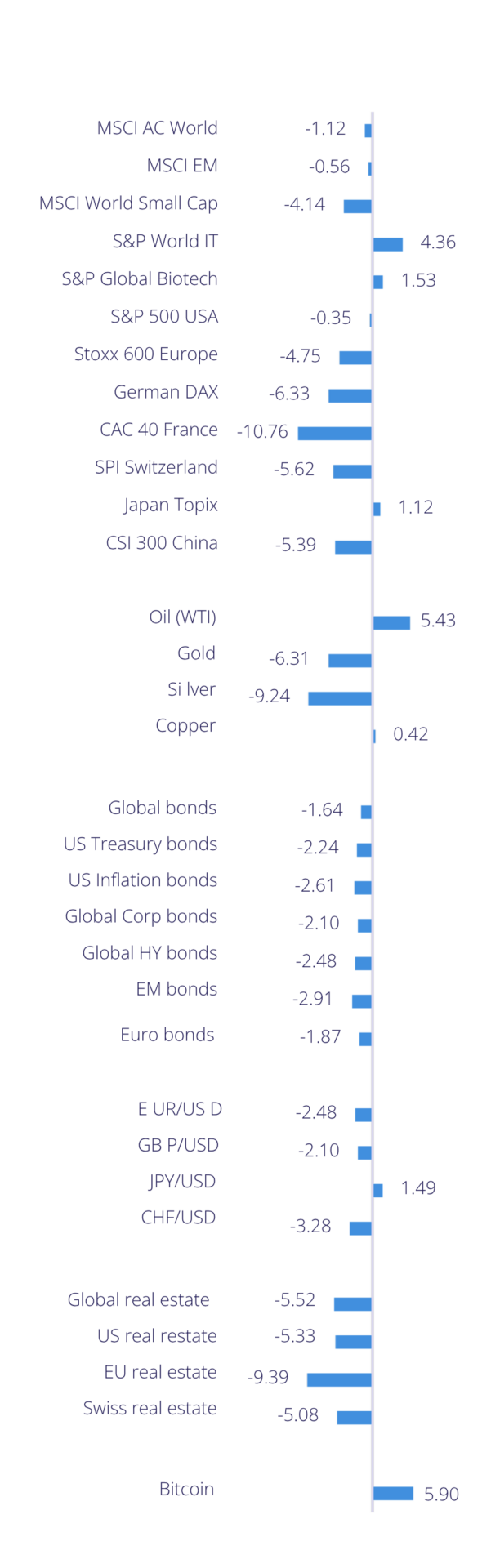
Scorecard

(In %, USD)

Monthly performances

Experts in what we do

The Views

Are interest rates out of control?

The rise in long-term interest rates observed since the beginning of the year accelerated in September. Bond yields with long maturities rose significantly in the United States, Canada, France, the United Kingdom, Germany, Japan and even Switzerland. Bond markets, particularly long-duration assets, are under pressure, while the implied interest-rate volatility index (MOVE) has risen above 100%, a level not seen since March. To date, the increase in interest-rate volatility has had a limited contagion effect on other asset classes, such as equities, as implied equity-market volatility (VIX) remains close to its lows. However, as has repeatedly been observed in recent years, there is a point at which the level and pace of rising interest rates can unsettle equity investors.

Several factors may explain this significant increase in rates. The most frequently cited is the United States’ fiscal position and debt burden. The country’s USD 40 trillion debt and 5.8% fiscal deficit are raising concerns ahead of the 2027 federal budget, which has yet to be approved and is unlikely to reduce the deficit materially. Politically, this may be the Republicans’ last opportunity to pass a budget before losing their majority in Congress. Overall, investors appear to believe that they are not being sufficiently compensated for assuming this credit risk over the long term.

The rise in yields is also supported by resilient economic activity. Recent GDP and manufacturing PMI data highlight the strength of the US economy despite the energy and supply-chain shocks triggered by the war in Iran. With nominal economic growth of 6.3%, a 5.2% yield on 10-year US Treasury bonds does not appear excessive and may even have further room to rise.

Higher energy prices have also contributed to rising inflation expectations and are frequently cited as another cause of higher interest rates. However, long-term inflation expectations remain relatively well anchored at around 2.5%, as investors continue to believe in central banks’ ability to combat inflation decisively. This should limit the risk of a disorderly rise in interest rates and may provide an upper bound.

Finally, sovereign bonds are facing competition from creditworthy corporate issuers offering higher yields, such as hyperscalers. Corporate bond issuance has been substantial in 2026, and strong demand has allowed the market to absorb this supply, potentially at the expense of US Treasury demand. In addition, foreign central banks continue to diversify their reserve assets, replacing US Treasury bonds with assets such as gold. This trend has accelerated since February, when the war in Iran began. Conversely, some jurisdictions where many hedge funds are domiciled, including the Cayman Islands, Bermuda or the United Kingdom, have recently increased their holdings of US Treasury bonds. Replacing “strong hands” with fast-money investors is likely to generate additional volatility.

Unfortunately, the Federal Reserve has limited influence over long-term interest rates. For instance, the only way to reduce long-term US bond yields would be to curb economic growth through a significant increase in its policy rate. Given the current US economic and political environment, we believe that entering a new tightening cycle is however unlikely. Nevertheless, we do not believe that long-term interest rates are likely to rise rapidly to excessively high levels. Momentum and volatility could push yields higher by year-end, but we expect the adjustment to remain orderly. It is worth noting that, at some point, higher yields should naturally attract bond investors once they consider the compensation sufficient for the risks involved. The time for investors to reconsider long-duration bonds is approaching; however, in our view, it is still too early.

Risk Indicator

The Bluebox risk indicator went into stress territory towards the end of the month. The situation in the Middle East, higher energy prices, or fast interest rates increases are pushing market and credit risk higher. It is noteworthy that sentiment risk has also been increasing, while liquidity risk remains at average levels. Our risk-based strategy initiated a deleveraging towards the end of the month.

The BlueBox Global Risk Indicator summarizes 20 market variables such as implied volatilities, implied correlations, or credit spreads into a normalized index. A positive number indicates a higher-than-average risk level, i.e. market stress. Low levels are indicators of normally behaving markets, while strongly negative readings (<-1) correspond to market complacency. The indicator is global and can be compared to a speedometer of financial markets. Please contact us for further information. 

July 2026

Equity and bond market indices recorded lacklustre performance

Global market performance shaped by geopolitical tensions, inflation concerns, and volatility in AI-related technology stocks.

Read article

May 2026

May marked the comeback of the 2025 return drivers.

Oil prices eased during the month on hopes of a diplomatic breakthrough.

Read article

September 2026

Rising interest rates and market volatility

An overview of September’s financial markets, examining rising bond yields, persistent inflationary pressures, geopolitical uncertainty and their impact on global asset classes, alongside BlueBox’s investment outlook and asset allocation strategy.

Read article