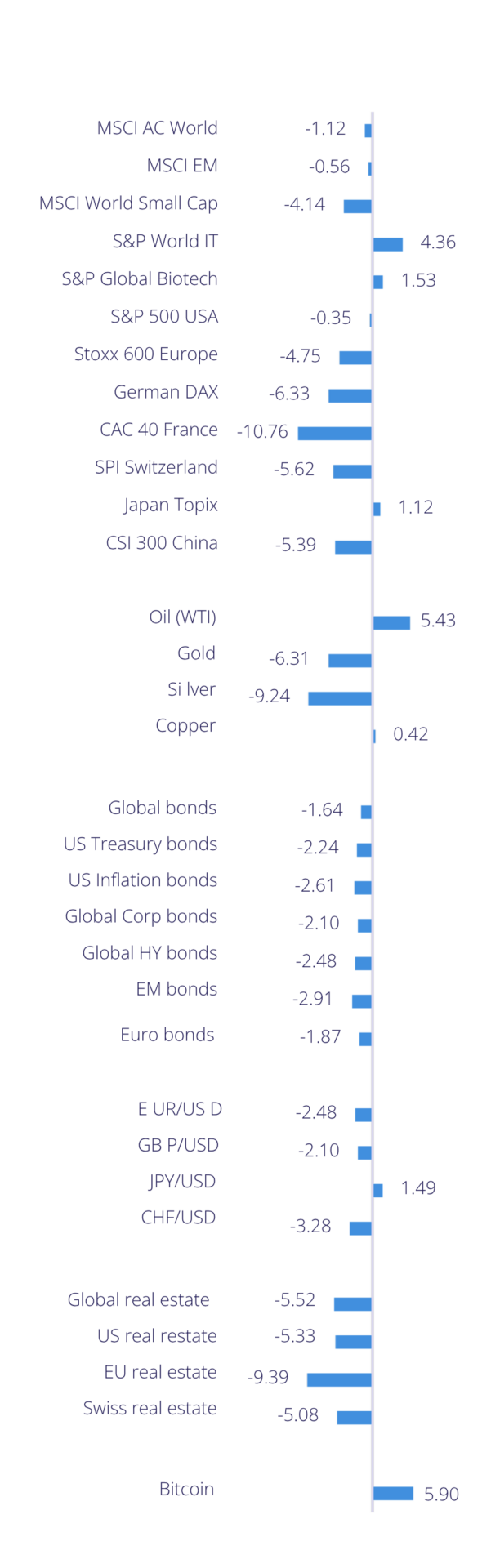


Following the summer recess, September proved challenging across most asset classes. Dispersion and volatility prevailed, with the technology sector again offering the only meaningful refuge.
The market narrative has centred on interest rates since late summer. Long-dated sovereign yields rose sharply in September, with the US 10-year Treasury yield increasing from 4.75% to 5.28%. The move was global and, in some cases, concerning given local fiscal dynamics. In France, the 10-year OAT yield reached 4.85%, widening the spread over the German 10-year Bund to around 130 basis points, levels not seen since the eurozone sovereign debt crisis of 2012. In this environment, broad bond indices declined by roughly 2% for the month and are only marginally positive year to date, while remaining under pressure.
Macroeconomic data releases broadly supported the case for a resilient economy. US quarter-on-quarter GDP surprised to the upside at 2.2%, while both manufacturing and services PMIs advanced comfortably into expansion territory in September. On the inflation front, the PCE price index, the Fed’s preferred gauge, edged down by 0.3 percentage points to 3%. However, this apparent improvement was largely methodological: the Bureau of Economic Analysis revised its calculation approach in its annual review, with an estimated −0.3 percentage-point impact, implying that underlying inflationary pressures have not materially eased.
Equity indices also struggled, with most finishing the month down or flat. More technology-concentrated benchmarks, such as the S&P 500 and the MSCI Emerging Markets Index, were roughly flat, as technology and communication services were the only sectors posting positive returns in September. Dispersion was elevated, with more highly leveraged sectors underperforming most sharply in response to higher rate levels. In Europe, France’s political and fiscal situation weighed on local equities, with the CAC 40 now negative year to date.
Gold surrendered almost all of its August gains, pressured by a stronger US dollar and higher real rates. Nevertheless, we continue to view the fundamental backdrop as supportive over the medium term. Bitcoin has increasingly been perceived as an alternative to bonds and equities, with its rebound continuing; in September, it was among the few asset classes posting positive returns and offering welcome diversification. Oil and distillates advanced for the month but retreated from recent highs, as unconfirmed reports regarding a potential US ban on diesel exports under President Trump introduced additional volatility.
Heightened political and geopolitical uncertainty, combined with significant moves in key market drivers, has blurred investors’ visibility. We maintain our current asset-allocation stance: a preference for technology within equities and short duration within fixed income.