
August 2026

Interest rates back in focus as markets reach new highs

Download as pdf

1

Stable inflation for July and hence a lower chance of a Fed rate hike allowed equities to reach new all-time highs at mid-month.

2

The ongoing tensions in the Middle East keep oil prices above $90/bbl. Short-term inflation expectations are increasing.

3

Long-term interest rates are moving up on solid economic growth, higher expected inflation and worries about US debt levels.

4

Precious metals and bitcoin are benefitting from political and economic policies uncertainties.

Authored by Gilles Prince
Chief Investment Officer

Experts in what we do

Last month

August was not only another very warm summer month; it was also rich in developments. First, we saw confirmation of exceptional earnings and revenue growth in the USA, supporting further equity gains. Second, the war in Iran shows no signs of easing, oil prices remain elevated, inflation fears have resurfaced, global uncertainty has increased, and gold and bitcoin have become more attractive. Finally, and not least, higher long-term interest rates have caught investors’ attention.

The successive heat waves we have experienced since June, with record-breaking temperatures, led us to prefer the cooler air of the Alpine mountain range. Reaching for the highs is precisely what financial markets did in August, with the S&P 500 touching 7,789 points mid-month. Equity markets reacted positively to reassuring inflation data at 3.4%, despite higher oil and gasoline prices, as the probability of Fed rate hikes declined.

The second-quarter earnings season also supported the positive sentiment, with earnings growth reaching an extraordinary 50% year on year, following 30% in the first quarter. The technology and energy sectors posted the highest year-on-year earnings growth, while healthcare surprised most with better-than-expected figures. Expected earnings growth for the third and fourth quarters remains at very high levels of 29% and 27%, respectively, before mechanically slowing in 2027. If these expectations are met, such a streak of strong earnings growth would be quite unusual outside an economic recovery phase. Like mountaineers in the Alps during a heatwave, it feels good to be at such highs, but as the heat persists the terrain becomes less stable and rocks may give way. High expectations are easier to disappoint, and even marginal bad news could hurt sentiment. Nevertheless, we maintain our preference for equities over bonds, as positive factors outweigh negative ones.

After a prolonged decline from the February highs, gold prices found stability over the summer around $4,000/oz before rebounding in August by nearly 10%. A weaker US dollar and higher near-term inflation expectations supported the rebound in precious metals. This nascent enthusiasm was, however, tempered after the Jackson Hole economic symposium, where Fed Chair Kevin Warsh made clearer his commitment to fighting inflation.

The other neglected asset, bitcoin, rebounded strongly in August as President Trump vocally supported the Clarity Act, a comprehensive cryptocurrency market-structure bill. Bitcoin ETFs recorded fresh inflows, signalling that institutional buyers were returning, while the sudden rebound forced some traders to unwind their short positions. It remains to be seen whether this technical relief has legs, but we have sympathy for growth assets that have been overlooked for some time.

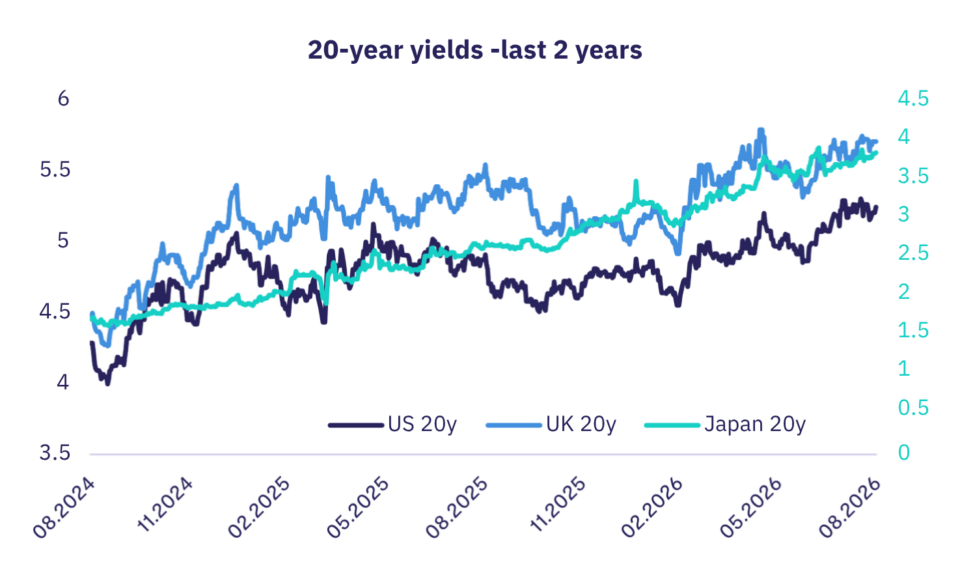
Finally, the market attention has switched to long-term interest rates that keep on climbing in most of developed markets. The 30-year US Treasury rate reached 5.30%, the highest level since 2007. We stay short duration.
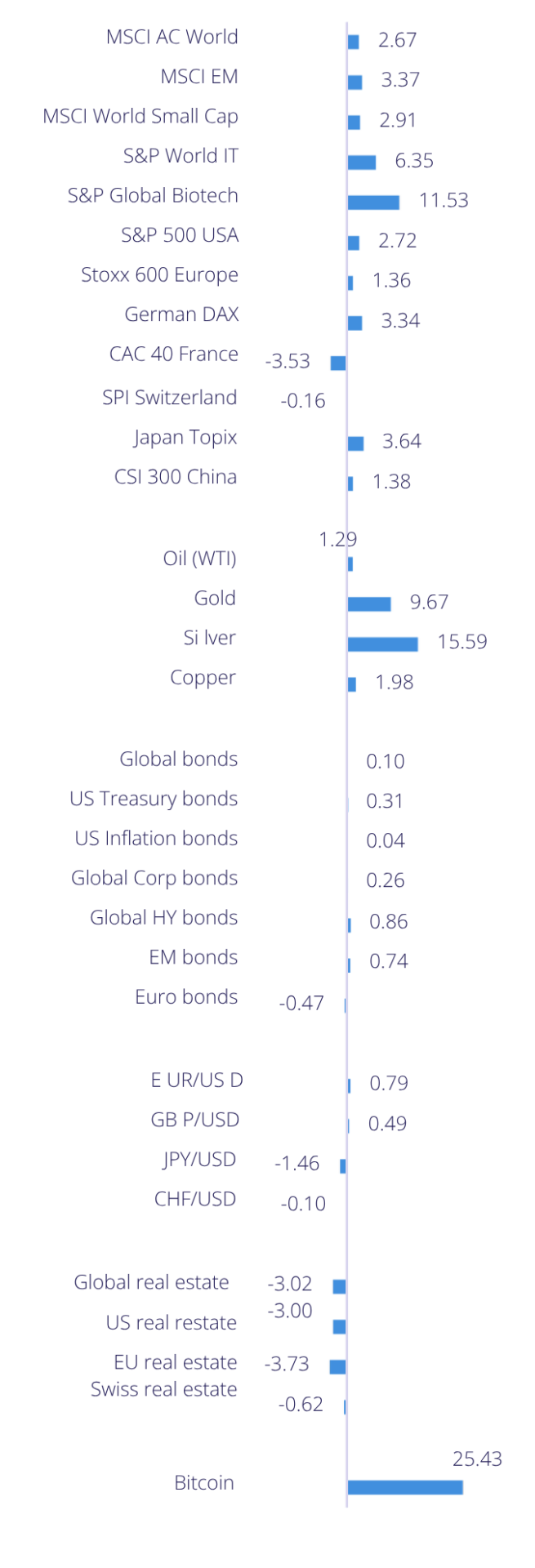
Scorecard

(In %, USD)

Monthly performances

Experts in what we do

The Views

Interest rates are back in focus

Although financial assets tend to reflect their fundamental value over the long term, in the short term investors are influenced by the prevailing market narrative. The focus can shift depending on economic developments, policies, political events, product innovation, or any factor that captures investors’ interest and affects financial returns. This can give rise to consensus trades, sometimes crowded trades, that may be unwound as fatigue sets in and a new narrative emerges.

As markets were temporarily reassured on the AI theme following the second-quarter earnings season, attention has shifted to rising interest rates. Ten- to thirty-year government bond yields have been trending higher since the beginning of the year across most developed markets. The 30-year US Treasury reached 5.30%, a level not seen in the past 19 years, while Japanese 20-year yields reached 3.9%, the highest since 1996. The US budget deficit and the $40 trillion debt level are cited as the root cause, or at least feature centrally in this narrative. A closer look reveals that other factors are also at play, such as resilient economic growth and persistently, and perhaps structurally, higher inflation. Importantly, rising political uncertainty and geopolitical tensions are impairing investor confidence in long-dated maturities. All of this is bearish for bonds.

To date, the increase in global interest rates has been orderly and has not created market stress. However, psychological levels, such as 5% for the US 10-year yield, could heighten investor nervousness. This is an important consideration, as the value of long-duration assets would be impaired by a higher cost of capital. The crowded AI theme is therefore at risk from both higher financing costs for infrastructure and a shifting narrative. As higher yields could trigger another growth scare and risk-off episode, we will monitor developments related to US Treasuries closely. If proof were needed that the situation is serious, the US Treasury has been buying US Treasury bonds in an attempt to keep yields in check. The initial market reaction has been to interpret this as a signal that the Treasury is prepared to do more, while it also shows that it finds the situation concerning.

In conclusion, if the rise in bond yields does not pause, the market narrative could turn decisively more bearish for equities. We view this potential shift in narrative as a risk, but we nevertheless remain in favour of equities, as the positive factors underpinning the uptrend in equity markets remain firmly in place.

Risk Indicator

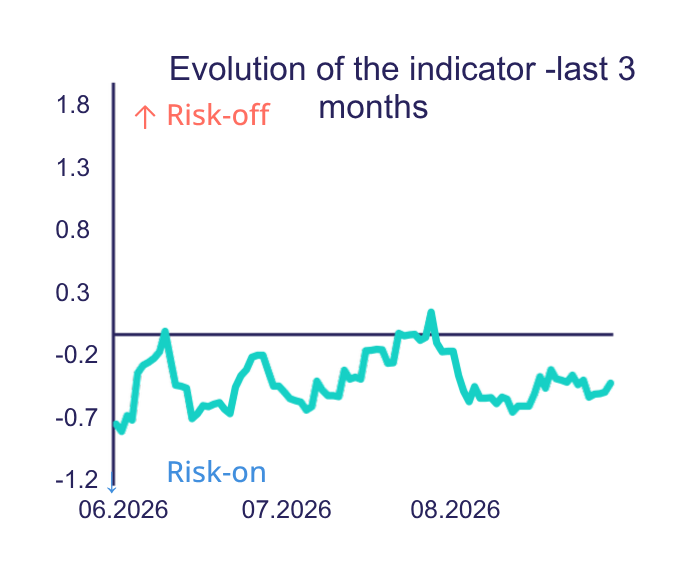
The Bluebox risk indicator has risen back toward neutral territory. Market stress has increased amid resurging tensions in the Middle East, higher interest rates, growing scepticism around AI and renewed inflation fears. Markets do not show signs of excessive stress, though we note some emerging discomfort that needs to be monitored.

The BlueBox Global Risk Indicator summarizes 20 market variables such as implied volatilities, implied correlations, or credit spreads into a normalized index. A positive number indicates a higher-than-average risk level, i.e. market stress. Low levels are indicators of normally behaving markets, while strongly negative readings (<-1) correspond to market complacency. The indicator is global and can be compared to a speedometer of financial markets. Please contact us for further information. 

March 2026

March has been a challenging month

Most asset classes declined, with the exceptions of energy prices and the US dollar.

Read article

May 2026

May marked the comeback of the 2025 return drivers.

Oil prices eased during the month on hopes of a diplomatic breakthrough.

Read article

June 2026

Was “Sell in May” the right call in the end?

Global markets paused as AI leadership shifted, inflation stayed elevated, and diversification became more critical.

Read article